When a mould, punch or machine part comes back from heat treatment, a familiar complaint follows: “The same end mill ran for hours in soft steel, but in the hardened part the corner broke after a few minutes.” In most cases the problem is not the tool itself but the fact that milling hardened steel follows different rules. This guide covers reading the hardness, choosing an end mill for hardened steel, using our 2026 catalogue data and avoiding the most costly mistakes. For the full series list and tables, see our carbide end mills for hardened steel page; here we focus on the “how”.
1. Know the hardness first, then choose the tool
“Hardened steel” is not one material: a tempered part at 30–45 HRC and a die steel above 50 HRC need different tools and programs. Before you start:
- Get the real hardness from the heat-treatment report or a measurement; if only tensile strength or HB is given, use the catalogue's hardness conversion table.
- Check the hardness symbol on the product page. In the Geppetto catalogue this symbol shows the recommended upper limit of the tool; for example, the MST, MC, MRS, MCL and MRC series are specified for <56 HRC.
- If your part is above that limit, talk to us before testing a standard series; a special tool with a geometry designed for the job may be the better option.
2. How to choose a carbide end mill for hardened steel
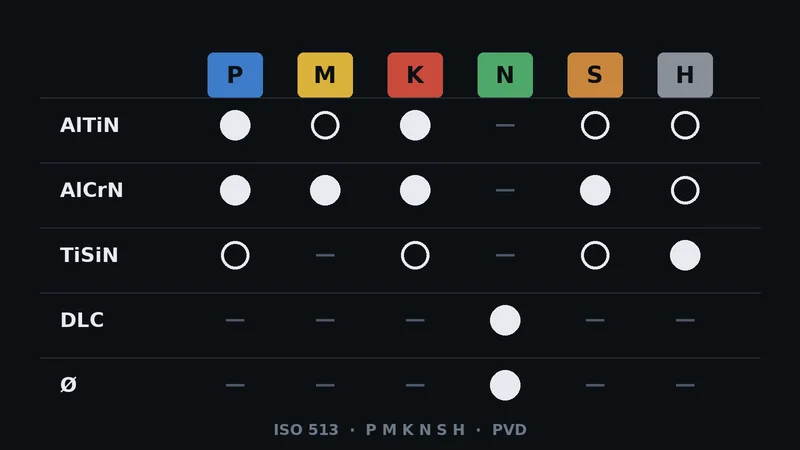
- Coating: The cutting zone gets very hot in hardened steel, so heat-resistant coatings such as TiSiN or AlCrN are the usual choice. The differences are explained in our coating guide.
- Number of flutes: Chips are thin in hard materials. Tools with 4 or 6 flutes and a strong core give rigidity and spread the load over more teeth.
- Corner protection: A sharp corner is the first thing to break in hardened steel. For roughing and deep areas, a corner-radius tool such as MRC (Z4) protects the corner.
- Length: If you do not need reach, use the shortest tool. Long-neck MCL (Z4) and MCL (Z6) are for deep areas only.
Examples from the 2026 catalogue: MST for micro diameters and fine details (Ø1.5–Ø5, Z4, TiSiN, 30° helix); MC (Z4, AlCrN) and MC (Z6, TiSiN) for roughing and semi-finishing; MRS (Z6) with chip-breaking serrations for roughing. The general logic of roughing is covered on our carbide roughing end mills page.
3. Cutting data: what changes when hardness goes up?
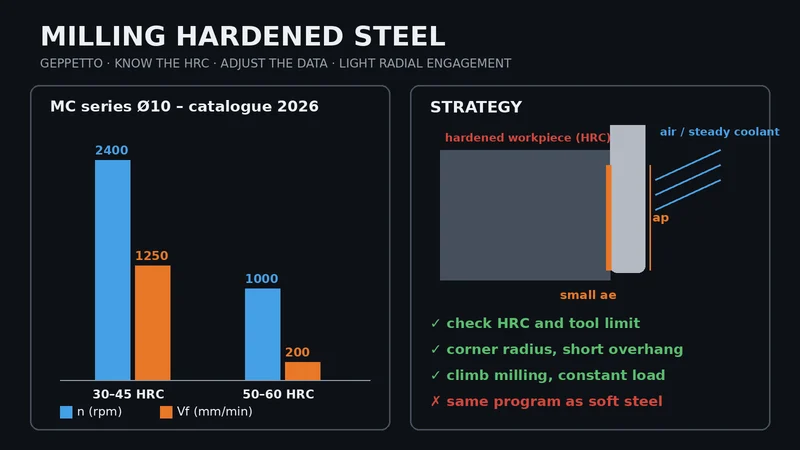
The most expensive mistake is running the soft-steel program unchanged after heat treatment. The MC series table in the 2026 catalogue (p. 139) shows the difference clearly. For an Ø10 MC:
- Alloy and tempered steels, 30–45 HRC: n = 2400 rpm, Vf = 1250 mm/min
- Hardened steels, 50–60 HRC: n = 1000 rpm, Vf = 200 mm/min
With Vc = π × D × n / 1000 this means a drop from about 75 m/min to about 31 m/min. For a 4-flute tool, fz = Vf / (n × Z) gives a feed per tooth falling from about 0.13 mm to 0.05 mm. Both speed and feed come down together; reducing only one of them is not enough. The catalogue also contains a separate “MC for high speed” table. It assumes a suitable spindle, rigid clamping and light engagement; do not mix the two tables. Use our speed and feed calculator to adapt the values to your diameter. Catalogue values are starting points; confirm them step by step on your machine.
4. Strategy: light radial engagement, constant load
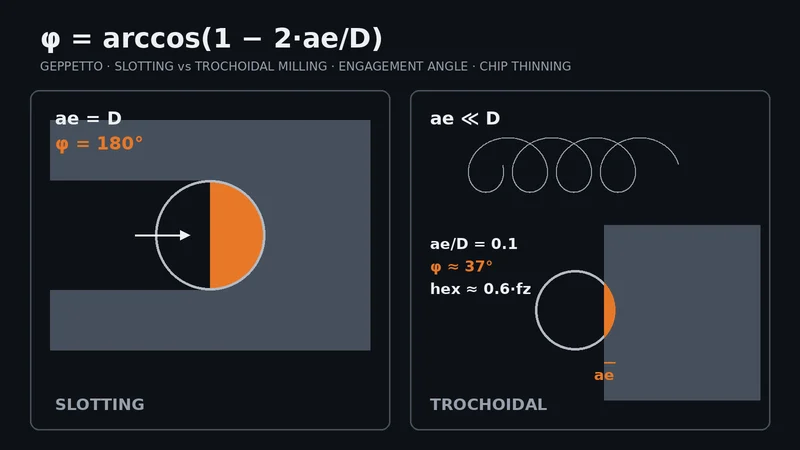
- Avoid full slotting. Full-width cuts maximise heat and force. A small radial depth (ae) with a larger axial depth (ap) uses the cutting length more evenly.
- Keep the engagement angle constant. Sudden load peaks in corners are a main cause of breakage in hard materials. Trochoidal and other constant-engagement toolpaths help here; see our trochoidal milling guide.
- Prefer climb milling. A tool that rubs its way into the material wears much faster.
- No dwelling, no rubbing. A tool spinning in one spot heats up and dulls the edge. Leave a small, even stock for finishing.
- Where possible, rough before heat treatment and only remove the remaining stock in the hardened state.
5. Coolant, rigidity and runout
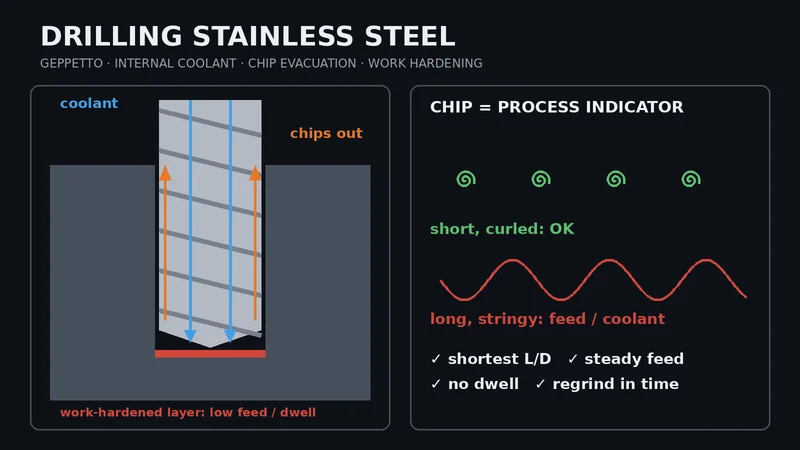
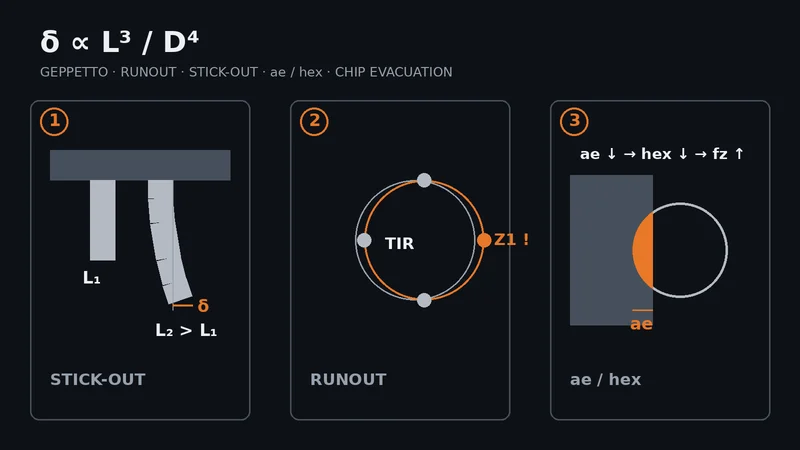
In many hardened-steel applications chips are cleared with compressed air. If liquid coolant is used, it should be continuous and generous; intermittent coolant can cause thermal shock and micro-cracks on the carbide edge. Without short overhang, solid clamping and low runout, even the right tool fails early. For chatter symptoms and runout checks, see our end mill breakage and chatter guide.
6. Catch wear in time and regrind
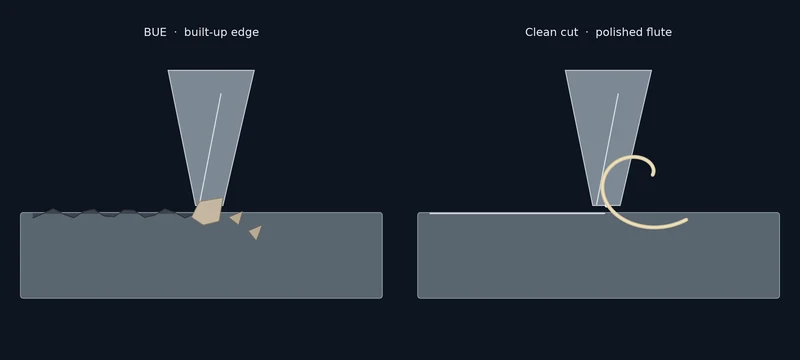
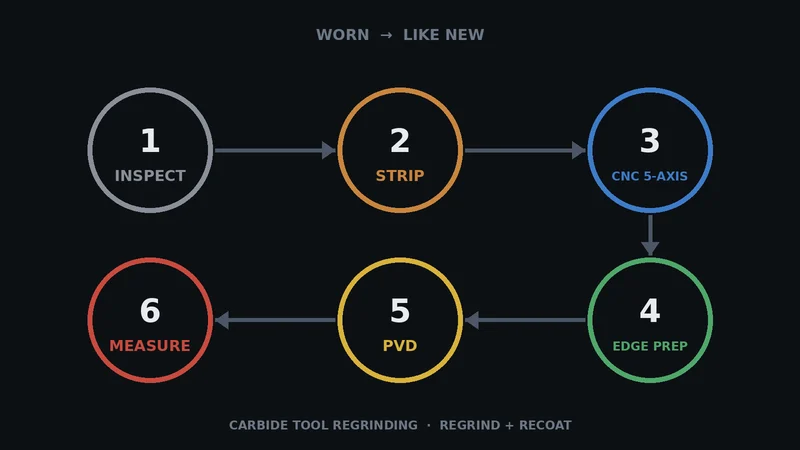
In hard materials, remove the tool when you see a shiny wear land on the flank, micro-chipping at the corner, more noise or spindle load, or a deteriorating surface. A tool run to breakage cannot be reground, while a tool removed in time can be reground to its original geometry and recoated. Besides its own tools, Geppetto offers regrinding and recoating for carbide tools of any brand.
Working with a carbide end mill manufacturer in Turkey
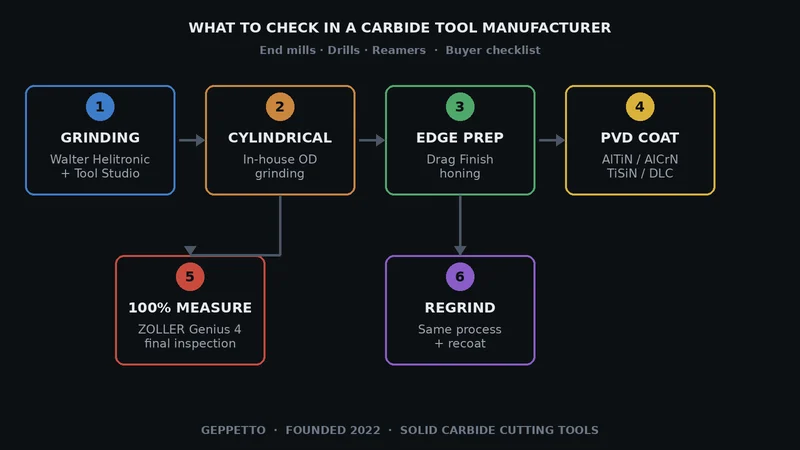
Geppetto, founded in 2022, is a solid-carbide tool manufacturer in Turkey. Our end mills are ground on Walter Helitronic machines with Tool Studio software, edge-prepared by drag finishing, PVD coated, and 100% inspected on a ZOLLER Genius 4 before shipment. With in-house cylindrical grinding, we produce standard catalogue series as well as special tools to drawing.
Conclusion
Success in hardened steel milling comes from knowing the hardness of the part, staying within the tool's catalogue hardness limit, reducing speed and feed together, keeping radial engagement small and the load constant, and regrinding tools in time. Send us the material, hardness and operation and we will help you choose: contact us, phone +90 216 394 41 10, WhatsApp +90 537 777 96 44, email info@geppetto-tr.com.
Frequently asked questions
Which carbide end mill should I use for hardened steel?
Choose a rigid, short tool with 4–6 flutes and a heat-resistant coating such as TiSiN or AlCrN. In the Geppetto 2026 catalogue, the MST, MC, MRS, MCL and MRC series are specified for <56 HRC.
Can I mill a part above 56 HRC with a standard end mill?
The hardness limit of these catalogue series is <56 HRC. For harder parts, talk to us before testing; a special tool designed for the job may be the better choice.
How much do speed and feed drop after heat treatment?
In the catalogue's MC table, an Ø10 tool runs at n = 2400 rpm and Vf = 1250 mm/min in 30–45 HRC steel, and at n = 1000 rpm and Vf = 200 mm/min in 50–60 HRC hardened steel.
Should I use coolant or air when milling hardened steel?
Many applications clear chips with compressed air. If you use liquid coolant, keep it continuous and generous; intermittent coolant can cause thermal shock in carbide.
Why do end mills break at the corner in hard materials?
Usually full slotting, load peaks in corners, a sharp corner, long overhang or runout. Small ae, constant engagement, a corner radius and a short tool reduce the risk.
Can end mills used in hardened steel be reground?
Yes, if they are removed in time and not broken. Geppetto regrinds and recoats carbide tools of any brand to their original geometry.