Why the coating matters so much
Two end mills with the same carbide substrate and the same geometry can deliver very different tool life in the same material simply because their coatings differ. A coating is a thin shield that protects the cutting edge from heat, wear and chip adhesion. The right coating allows higher cutting speeds and longer tool life; the wrong one adds little and, in some materials, can even increase built-up edge.
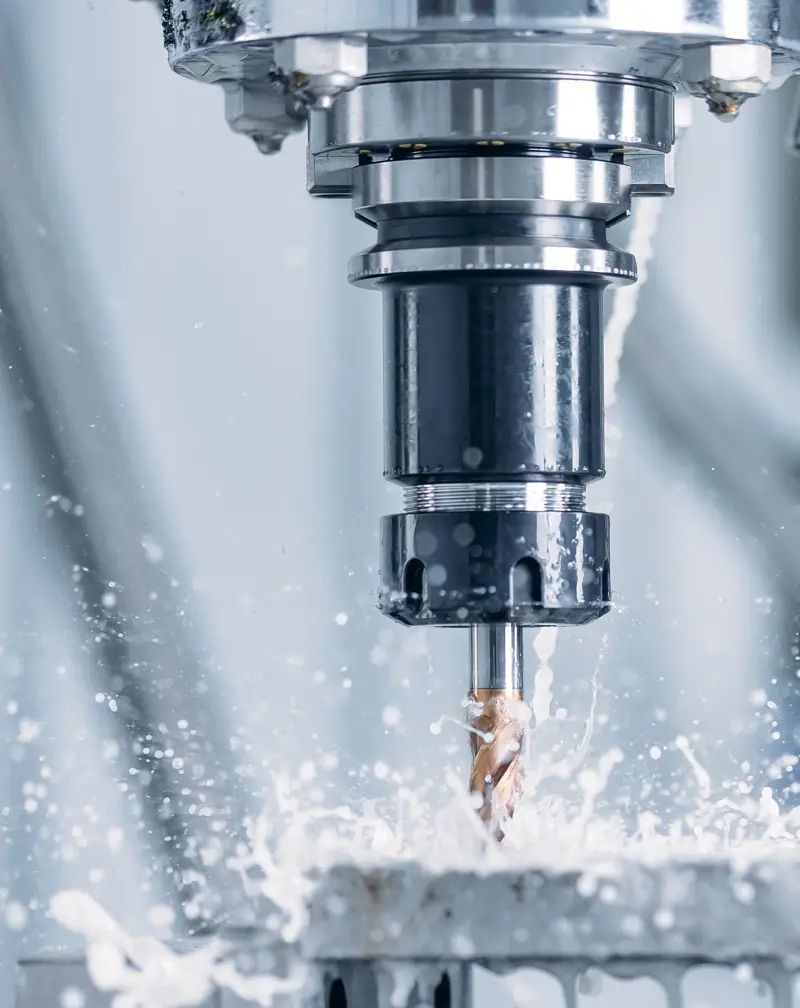
Most coatings on carbide end mills, drills and reamers are applied by PVD (physical vapour deposition). They are only a few microns thick, so the sharpness of the edge is largely preserved. One point is worth keeping in mind, though: a coating does not compensate for the wrong geometry or unsuitable cutting data. Choose the right tool type and geometry first, then the right coating.
How to read the chart
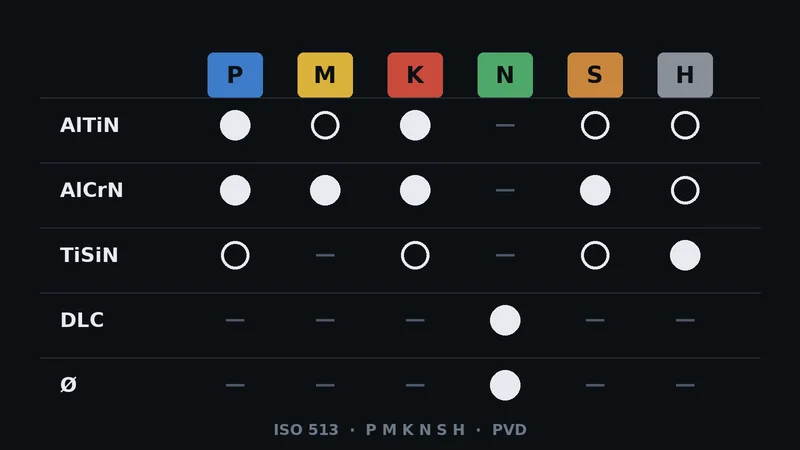
In the chart at the top of this article, rows are coatings and columns are the ISO 513 material groups: P (steel), M (stainless steel), K (cast iron), N (aluminium and non-ferrous metals), S (titanium and heat-resistant superalloys) and H (hardened steel). A filled dot marks a typical first choice, a ring a usable option, and a dash a combination that is generally not recommended. The Ø row stands for uncoated tools. The chart is a general guide; the final choice should follow the tool manufacturer’s catalogue and your actual machining conditions.
AlTiN: the heat-resistant all-rounder
Thanks to its high aluminium content, AlTiN (aluminium titanium nitride) forms a protective aluminium oxide layer on its surface during cutting. This layer keeps heat away from the tool, which is why AlTiN performs well at high cutting speeds and in dry or minimum-quantity-lubrication machining. It is a common choice for carbon steels, alloy steels and cast iron. It is not recommended for aluminium: the aluminium in the coating has a chemical affinity with the workpiece and can increase built-up edge.
AlCrN: toughness and wear resistance
AlCrN (aluminium chromium nitride) combines high oxidation resistance with good toughness and wear resistance. It behaves in a balanced way in interrupted cuts, in vibration-prone jobs and in wet machining. For these reasons it is widely used for steel, stainless steel and cast iron, and also for titanium alloys. It is a good starting point for roughing and for general-purpose tools that must cover a wide range of materials.
TiSiN: hardened steel and die & mould work
TiSiN (titanium silicon nitride) reaches very high hardness thanks to its nanocomposite structure. It stands out in milling hardened steels, in die and mould making and in high-speed finishing. The trade-off for that hardness is that it is less forgiving of impact than AlCrN, so it works best with secure clamping, low runout and a rigid machine.
DLC and uncoated tools: aluminium and non-ferrous metals
In aluminium the main problem is not wear but chips sticking to the cutting edge. The low friction of DLC (diamond-like carbon) reduces this adhesion and gives good results in aluminium, copper alloys and plastics. DLC is not suitable for ferrous materials because carbon diffuses into iron at high temperatures. Another common option for aluminium is an uncoated carbide end mill with a sharp edge and polished flutes.
Quick selection by material
- Steel (P): AlTiN or AlCrN.
- Stainless steel (M): AlCrN; toughness and resistance to adhesion matter.
- Cast iron (K): AlTiN or AlCrN.
- Aluminium and non-ferrous metals (N): DLC or an uncoated tool with polished flutes.
- Titanium and superalloys (S): mostly AlCrN, with low cutting speed and plenty of coolant.
- Hardened steel (H): TiSiN.
Coatings and cutting data
A coating lets the tool work at higher temperatures, but it is not a licence to raise the cutting speed at will. Take starting values from the tool catalogue for your material group, then adjust while watching the wear pattern. Rapid flank wear often points to excessive cutting speed, while edge chipping can indicate too much feed, vibration or runout. To calculate spindle speed and feed quickly, use our cutting data calculator.
Recoating after regrinding
When a carbide tool is reground, the coating is removed from the ground faces and the bare carbide substrate is exposed. The uncoated area will not perform like the original tool. That is why professional regrinding should restore the geometry to its original dimensions and then add edge preparation and a new coating. Rounding the edge in a controlled way before coating helps the coating adhere at the edge; we covered this in our article on Drag Finish edge preparation.
Depending on the series, Geppetto’s carbide end mills, drills and reamers are supplied with AlTiN, AlCrN or TiSiN coating or uncoated; see the products page for the series. Our regrinding service offers AlTiN, TiSiN, AlCrN and DLC recoating options.
Conclusion
Coating selection starts with the workpiece material: AlTiN or AlCrN for steel and cast iron, AlCrN for stainless steel and titanium, TiSiN for hardened steel, and DLC or an uncoated tool for aluminium are sound starting points. If you would like to choose the right tool and coating for your application together with us, get in touch: phone +90 216 394 41 10, WhatsApp +90 537 777 96 44, email info@geppetto-tr.com.